
Country: South Africa
Location: Marakele National Park, Limpopo Province. South Africa
Travel Date: April 2015
Driving 4 hours North West of Johannesburg after a 20-hour flight from Mumbai was one of the craziest things I could do…or so I thought.
Driving up N1 on crisp blue winter morning from Jo’burg’s O R Tambo International Airport towards Polokwane in a brand new rental Mercedes C-class, Helen’s words kept haunting me…its magical.
What was so magical? Well the drive itself was magical to start of with.
A very comfortable 120 km/h on the speedometer…cruise control on…check. Feet up on the seat…check. Sunroof open…check. Coffee in hand…check. Now I am set. The fields roll out in front of me as I whizz down the hard top.
Cruising down that highway I again thought to myself. Why did I do this? My answer came 4 hours later as I turned off the highway to pass Hoopsdal Police Station (my last landmark before the entry gate). Here Mac the security guard greeted me with a indemnity form stating that I am now responsible for my own life and property. Fair enough. Wild animals are unpredictable just as most humans. Signed off and was ready to go. Before I took off…Mac gave me last minute instructions. Follow the road for 7 kms. Cross the wooden bridge…then take a right.
Sounds like fun just 7 kms to go before a hot shower and a cold beer. I was wrong. This was the longest 7 kms I ever drove. Mercedes Benz C –Class…bad move. I had to watch every bump and stone in the road, these vehicles aren’t designed for dirt tracks. So here I am with my nose stuck to the windscreen and staring straight down in front of me when I see it! Fresh elephant poo! I see some trees knocked down as well. Now I am worried.
Elephant dung, knocked down trees and I am thinking Male elephant in musth is probably the worst thing that you can encounter in the wild. Musth is a period when a male elephant’s testosterone is at its highest. This bloke is ready to mate and gets extremely aggressive. Best way to recognise an elephant in musth is the secretion from its temporal duct behind the eye which make it look as though its crying.
Now I am on my guard as I inch forward with my foot now hovering between the brake and accelerator. More destruction and I head on. More dung too…and then I see…HER.
Very docile chomping away on the leaves not giving a hoot about my presence. I pull over to have a look. All is well she is happy and I am too as I take off leaving her gazing at me with utmost disinterest.
Finally I arrive at the lodge with a few impala encounters skipping, hopping and darting all around the bush like little children playing in the garden.

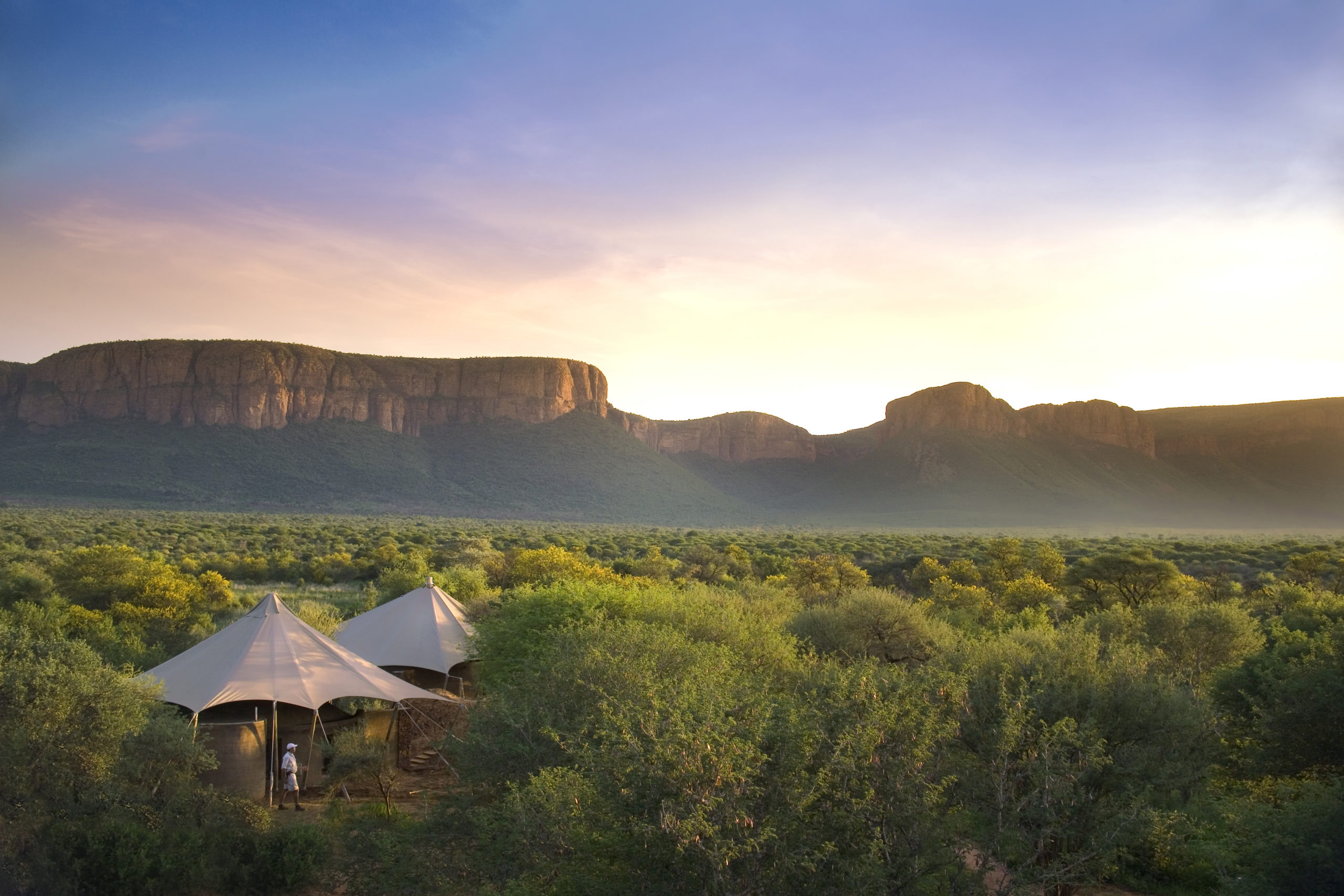
As I step out of my vehicle a big friendly “hello hello” greets me. Cold towel and a cold drink greet me on arrival as I am quickly chaperoned into the lounge area. Quick introductions and as I sign another declaration form I look over my shoulder…and there it is. The Magic of Marataba, a stunningly beautiful mountain range with grasslands before it.
Remember I was there by lunch so it was a pale yellow range, which reminded me of the old western movies such as McKenna’s Gold. I half expected Gregory Peck and Omar Sharif gallop in front of the property.
I was then led to my tented suite. It was circular in shape with a deck overlooking the semi dry river in front. On entering the room I was hit by the coolness of the air conditioning.
The layout of the room was really spacious with well-appointed interiors. A large king bed stood in the middle with a writing desk off to the side . What got my attention was the open style bathroom with a free standing stone bathtub and a rain shower. Both looked out over the river and up to the mountain range in the distance. I never got to use any of them as I trotted out to the outdoor shower with the same view and cool river water soon ran over my head.. The attention to detail in the design of the room was absolutely impeccable. Everything was within reach but in its own space.
A quick brief about the property. Marataba Safari Lodge has 15-tented suites for 30 guests. Children above 6 of age are welcome. I saw a bunch in the pool while I was walking towards the room with a herd of impalas surrounding them. Took me back to the earlier thought of impala’s in the garden…here they were.
I am getting sidetracked…so children activities and babysitting is also available and its possible to have a family room configuration as well. The open plan lounge and dining area are very spacious and inviting. They also have recliners on the deck to stare out in the distance at the mountains. I saw an old gent before I went for my shower on one of those recliners starting out into space, mesmerised by the scene that lay in front of him…and found him in the same spot, doing exactly the same thing when I return 40 minutes later for lunch. This was the magic of Marataba.
A little note for our tech savvy travelers. Wifi is available in the public areas. But honestly this is really not the place to be connected with the real world. Switch off and enjoy the magic of Marataba.
Lunch was light and easy. Gazpacho, salad and a burger. All extremely yummy and well balanced by Windhoek Lager. By the time I finished with my late lunch tea and coffee were set out just before our game drive. Hein our ranger who would take me out into the bush with another Dutch couple met me at the lounge.
I mention this, as this Missus was about to soon be the heroine of a saga later during the drive.
Driving through the bush we spotted a lot of plains game and birds and then we rounded a curve to come face to face with a white Rhino mama and her 2-year-old baby. A very nice sighting, as both were very peaceful and relaxed within a herd of Wildebeest only to be periodically disturbed by male impalas scampering around grunting as the rutting season was in full swing.
Leaving that lovely moment behind we headed over to the dam where I was scheduled to get on board MS. MARA. As we rounded a turn we spotted a large bull elephant in the bush just of the trail. As we approached he began showing some interest in us. Just as we passed him he began chasing us and Hein did the unthinkable…he stopped the vehicle…and switched the engine off. Now I am thinking to myself, back in East Africa we leave the engine on and if anything we rev the engine to say good-bye to the Massif. Not here.
They have a different thought process, which made solid sense. If they ran… the Ellie would chase and that’s not a good idea to teach these extremely smart blighters, as they will start chasing guest vehicles as the come up to the lodge… remember the docile female I encountered? So now I got it. In this haze I hear Hein’s voice talking to the elephant… calm and gentle telling him to go away. I look back and this large bull has locked eyes with the lady at the back. Slowly giving her the look over…men I say, they will never change.
For a good 5 minutes he is looking at her as he is thoughtfully chomping away at the brush. I might add his trunk is just 1 foot away from her. She could have been an attraction at Madam Tussaud’s, she was so stiff. I don’t blame her this was too close for comfort. No one was breathing and you could smell the fear in the air. Finally even the elephant had had enough. With a sidelong glance, as if to say “I’ll see you later mate” he sauntered off into the bush. Visible sigh of relief all over as we drove off to catch Ms. Mara.
As we reached the landing dock I saw the prettiest sight ever, there she was moored to the bank amidst the backdrop of those mountains again, which were now a pinkish bluish hue. Stunning! Off we went on the dam in Ms. Mara, which is a boat with basically two sets of inflatables on both sides and a deck for guest to relax and enjoy sun downers. I won’t go into details of this as words cannot explain the experience and the emotion on this ride. One has to experience this to understand.
With enough Droewors and Bells inside me it was time to rejoin the flying Dutchman and his lady love on a night safari back to the lodge. It seems they drove around a bit and saw some general game before they returned to fetch me and now as the evening got colder, we were all set to head back.
The lodge had transformed itself. Warm fires and lanterns lit up the parking lot and we were greeted with hot towels and glasses of wine and sherry. Total pleasure…with glass in hand we headed up to the bonfire overlooking those mysterious mountains again. Here we met up with the other guests of the hotel and swapped stories before each heading off to their tables for an early dinner. Dinner was again Table d’ hote and stunning. I distinctly remember the juiciness of the meat and the flavour of the sauce, before I hit the sack and into oblivion.
The next morning started off at 5 am with lions roaring in the distance. I quickly showered and ran up to the lounge area with the hope of spotting them from there while I sipped on some hot coffee. No luck but I could hear them calling out to each other as they got closer and closer. As soon as Hein turned up along with the Dutch we were off in hot pursuit. All the lodge vehicles had split up to try and locate them. It was Jomi who spotted them first. 4 of them, 2 males and 2 females. The females looked really hungry and one was in oestrus and the males, well one was extremely lazy and one had different ideas for one of the lionesses. We trailed them for over an hour, watching the females stalk a herd of wildebeest only to be constantly interrupted by the frisky male who had only one agenda…to mate with the female, making it impossible for the ladies to hunt. They gave up and we moved on. After a quick coffee break I headed over to the Marataba Trails Lodge.

Now we are talking. Set up in a valley with stunning views of the forest below is Marataba Trails Lodge, now renamed as Marataba Mountain Lodge. A five-suite lodge (maximum 8 people) built into the mountain. The concept “switch off”. No electricity, only solar lighting. No kids below 16 since everything is open to the wild and kids can be unpredictable on walks.
One single dining table for community dining as one would do at home. Really nice, considering there is nothing else to do here anyways in the evening.
The premise of this property is walking the trails around the property. Everything here is about nature. Early in the morning you choose your breakfast and pack it into your knapsack. Then off you go with one guide in the front and one at the back. The trails range from trekking over the top of the Kransberg Range to traversing through the gorges. The slowest guest determines the difficulty of the trek. It really doesn’t matter where you go, you will always encounter wildlife and that’s what makes this unique from any other property, as there are no vehicles to scare them away just you.
In the evening after a shorter walk one can sit by the fire pit and swap stories watching the sun lazily go down as the mountain range constantly changes colour… This is the way I will always remember Marataba…a place truly magical.